North Castle: A Town that Helped Shape the American Revolution
During the Revolutionary War, North Castle played a vital role in securing American independence. Key moments in our town’s history include:
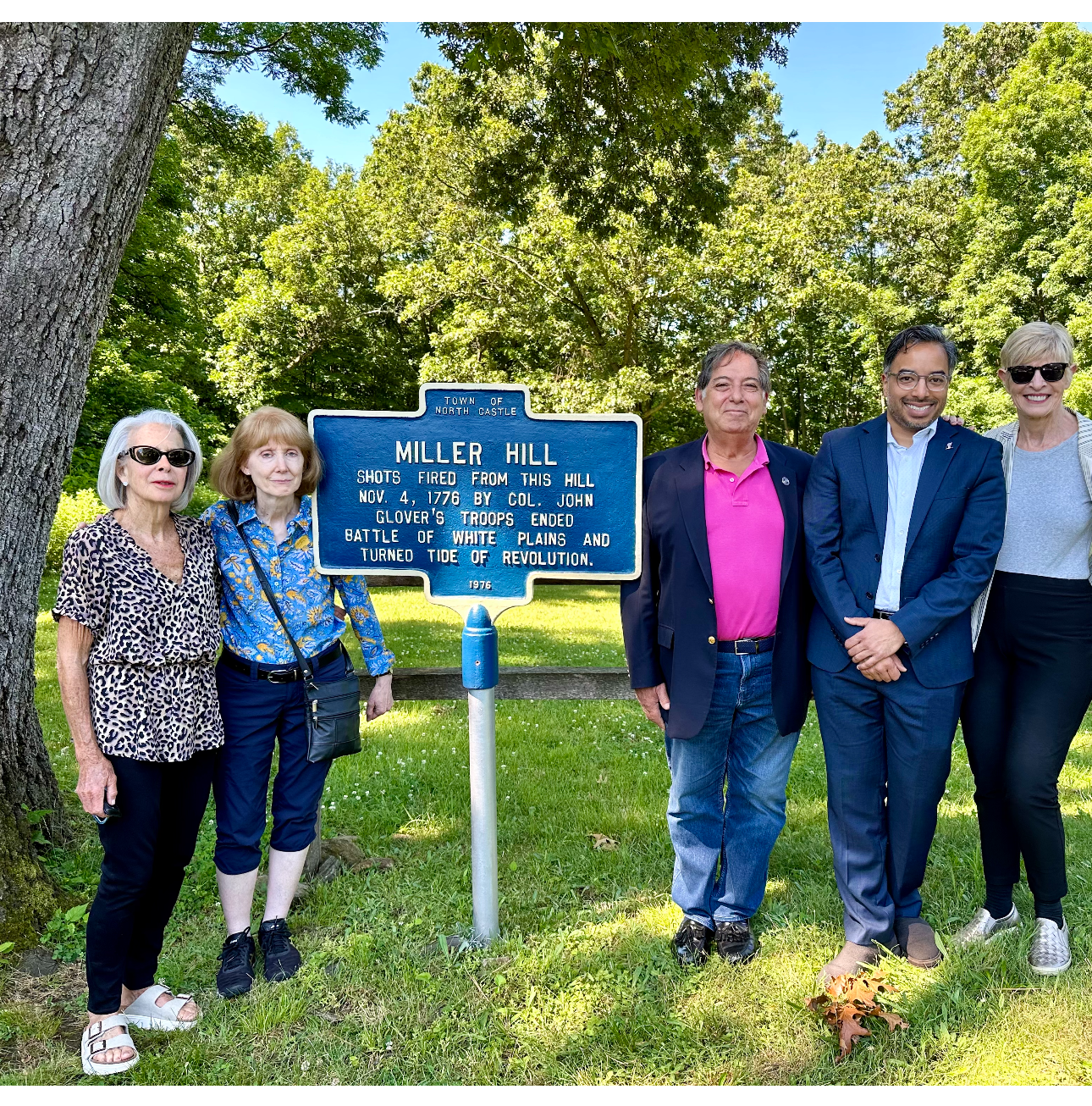
Miller Hill & the Continental Army
North Castle served as a strategic military encampment protecting New York’s vital Hudson River corridor.
Battle of White Plains
Another Loss and a First Win for soldiers from North Castle.
The Story of the North Castle Afghan
The afghan displays the Town of North Castle Seal in the center with six historic sites surrounding the Seal. In each corner of the afghan are symbols with historic significance to the settlement of the Town.
The Town Seal
(For the description of the Town Seal, see the poster on left-hand wall).
Smith’s Tavern – 440 Bedford Road – Armonk - Listed on the National Register
Dating back to the American Revolution, Smith's Tavern has served as a militia headquarters, a stagecoach stop, Town Hall, a voting place and the first North Castle Post Office.
Miller House – 140 Virginia Road – North White Plains - Listed on the National Register
The Miller House, also known as Washington’s Headquarters Museum, is an 18th-century style farmhouse owned by Elijah and Anne Miller. In October 1776, it served as a command post during the Battle of White Plains, which took place virtually outside their door.
Widow Brush’s House – 46 Bedford Banksville Road, Bedford
This double chimney farmhouse was built circa 1750, and became the Westchester Women's Golf and Tennis Club. It flourished until the 1929 financial "crash,” and was followed by the Middle Patent Golf Club, with both men and women enjoying membership. Later Mr. Jackson sold it to Antoine Gilly, and the famous French Restaurant "La Cremaillere ala Campagne" came to Banksville. The house has had wings and porches added.
1798 Quaker Meeting House – 440 Bedford Road, Armonk
This 1798 Quaker Meeting House is about 50 feet by 30 feet with massive hand-hewn beams and supports, all carefully dovetailed and held together with wooden pegs. The outside walls are covered by hand-hewn 4-foot shingles, secured with iron nails hand-wrought under the guidance of the village blacksmith. During the great Orthodox-Hicksite Controversy in 1828, the Meeting divided with the Orthodox meeting outside under the trees, and the Hicksites, the larger group, meeting in the house. In 1872 the Armonk Meeting was discontinued. Over the years, it became a carriage house, barn and tractor shed, owned by members of the Carpenter, Cox and Purdy families and George S. Leisure, Esq. The Historical Society moved the structure from the old Leisure Farm property, piece by piece, to the complex and began restoration in 1991.
East Middle Patent One-Room Schoolhouse – 440 Bedford Road, Armonk
From the early 1800s until the mid-1950s, the East Middle Patent School was a North Castle school, but in 1957, the East Middle Patent School was annexed to the Bedford School District. The school was closed in 1962. Vacant for many years, The North Castle Historical Society purchased the school building in the early 1980’s from the Bedford School District for $1. The old building was cut in half, placed on two flatbed trucks and moved to its new home and dedicated on August 24, 1986. It continues to serve students of all ages by giving them the “one-room school” experience.
Brundage Blacksmith Shop – 440 Bedford Road, Armonk
The Old Brundage Blacksmith Shop offered community services where horses and oxen were shod, and household implements were made and sold for nearly one and a half centuries. In the 1850's, this blacksmith shop stood diagonally across Rte 22. The blacksmith shop was operated by James Edward Stivers until 1870, when Maurice Brundage took over. Now on display, one can see the original forge, anvil and bellows, as well as a one-horse open sleigh. The old ox-cramp shed shows how the oxen were lifted during shodding, as the oxen cannot stand on three feet. The Brundage Blacksmith Shop was added to the complex in 1981.
Symbols in the corners - Spinning Wheel
During the American Revolutionary period the spinning wheel was used to produce homespun cloth, rather than depend on textiles from Great Britain. It served dual purposes – turning clumps of fiber into yarn, but also symbolized independence.
Symbols in the corners - Stagecoach and Horses
Stagecoaches transported passengers and packages over long distances. They brought communication and trade to settlements linked on the routes. Historic Smith's Tavern was a stagecoach stop on the Danbury Post Road, today's New York State Route 22.
Symbols in the corners - Arrow
A single arrow during Colonial and Revolutionary times represented protection and defense and war. Arrows were the tools for survival and self-defense.
Symbols in the corners - Musket and Cartridge Pouch
The musket and cartridge pouch represented how the role of the local citizen militia was central to defense and self-reliance needed to protect the community and became one of the symbols of the American Revolution.